

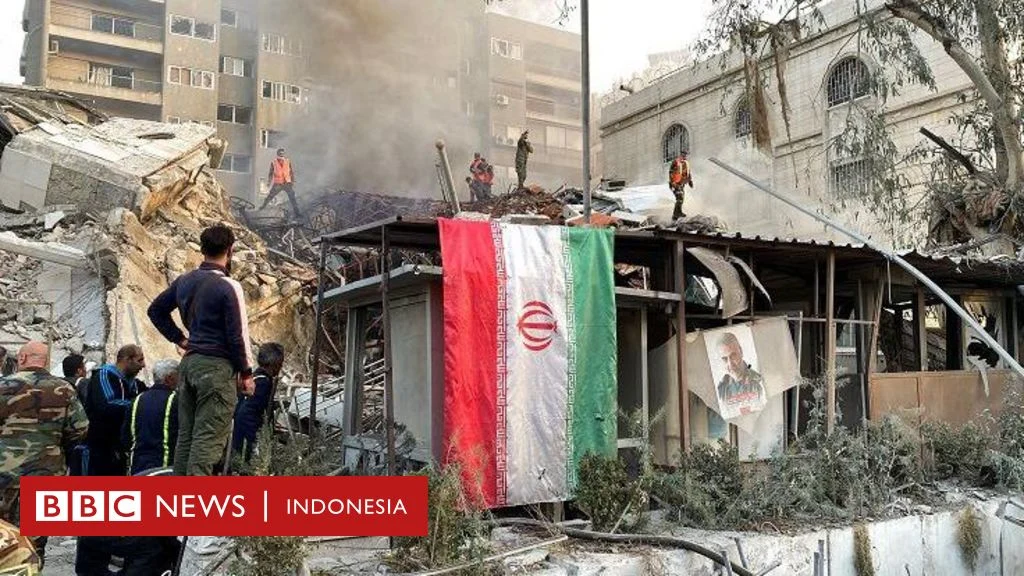
Media Kampung – 04 April 2026 | Iran‘s IRGC launched massive missile salvo targeting US and allied installations in the Middle East after the United States used a British base for logistics. The operation marks a new escalation in Tehran’s campaign against Western forces.
Four Ghadr ballistic missiles were fired toward the aircraft carrier USS Abraham Lincoln, which was operating near the Gulf of Oman. The strikes reportedly hit the flight deck and damaged critical radar systems.
Press TV reported that the missiles caused extensive damage to the carrier’s deck and temporarily disabled its air‑defense capabilities. The incident is being treated as a direct response to perceived US aggression.
At the same time, IRGC forces destroyed the AN/TPY‑2 radar of the THAAD system at Prince Sultan Air Base in Saudi Arabia. The radar, valued at billions of rupiah, was a key component of the regional early‑warning network.
The loss of the radar undermines US missile‑defence posture and heightens tensions with NATO allies. Iranian officials warned that similar strikes could target other allied installations.
Iran also confirmed that a US fighter jet was shot down over its territory, marking the first such loss in the current conflict. The aircraft, identified as an F‑15, crashed near Khuzestan province.
Tehran offered a monetary reward for the capture of the downed pilot, signaling a willingness to intensify psychological pressure on US forces. The claim has been echoed by several Iranian media outlets.
Following these actions, Iranian authorities announced that British military bases in the Persian Gulf are now legitimate targets. The declaration came after British troops provided logistical support to US naval units.
Iranian defense officials warned that any further use of allied bases will trigger an all‑out strike by the Revolutionary Guard. They emphasized that the UK installation is no longer immune to retaliation.
Analysts note that the inclusion of the UK base expands Iran’s strategic calculus and reflects a broader coalition against Western presence. The move may compel other regional powers to reassess their security commitments.
On the ground, IRGC units are fortifying islands such as Kharg and Qeshm with anti‑ship missiles and extensive minefields. Satellite images show new launch pads and hardened shelters being constructed.
Independent observers have documented the re‑activation of Cold War‑era tunnel networks on those islands, intended for ammunition storage and covert movement. The infrastructure enhances Iran’s capacity for sustained operations.
Sanam Vakil of Chatham House warned that Iran could employ swarm‑drone attacks before launching conventional missiles, complicating defence planning. Such tactics aim to overwhelm air‑defence systems.
A senior Pentagon official indicated that US force‑protection measures are under review but declined to comment on specific incidents. The United States has not issued an official statement on the carrier attack.
NATO officials expressed concern that the destruction of the THAAD radar could weaken collective defence commitments in the region. They called for increased coordination among member states.
Regional governments, including the United Arab Emirates, have issued alerts for civilian aircraft, designating parts of the Gulf as a red zone. Commercial traffic is being rerouted to avoid potential engagement zones.
Despite heightened risk, US and allied navies continue to patrol international waters, citing freedom of navigation principles. Their presence is intended to deter further Iranian aggression.
Iran’s aggressive posture reflects a strategy to deter any future ground invasion by the United States. Tehran has mobilized thousands of troops along its coastline in preparation.
The Iranian parliament’s security commission announced increased funding for coastal defences and rapid‑response missile units. Budget allocations underscore the priority given to maritime security.
International observers caution that further escalation could disrupt global oil supply routes through the Strait of Hormuz. Any closure of the strait would have far‑reaching economic consequences.
Diplomatic channels remain open, but both sides have exchanged stark warnings, indicating limited room for de‑escalation. The risk of a broader conflict remains high.
The evolving situation underscores a volatile security environment where former allies become adversaries, and regional stability hangs in a precarious balance.
Artikel ini dipublikasikan oleh Media Kampung.







Tinggalkan Balasan