

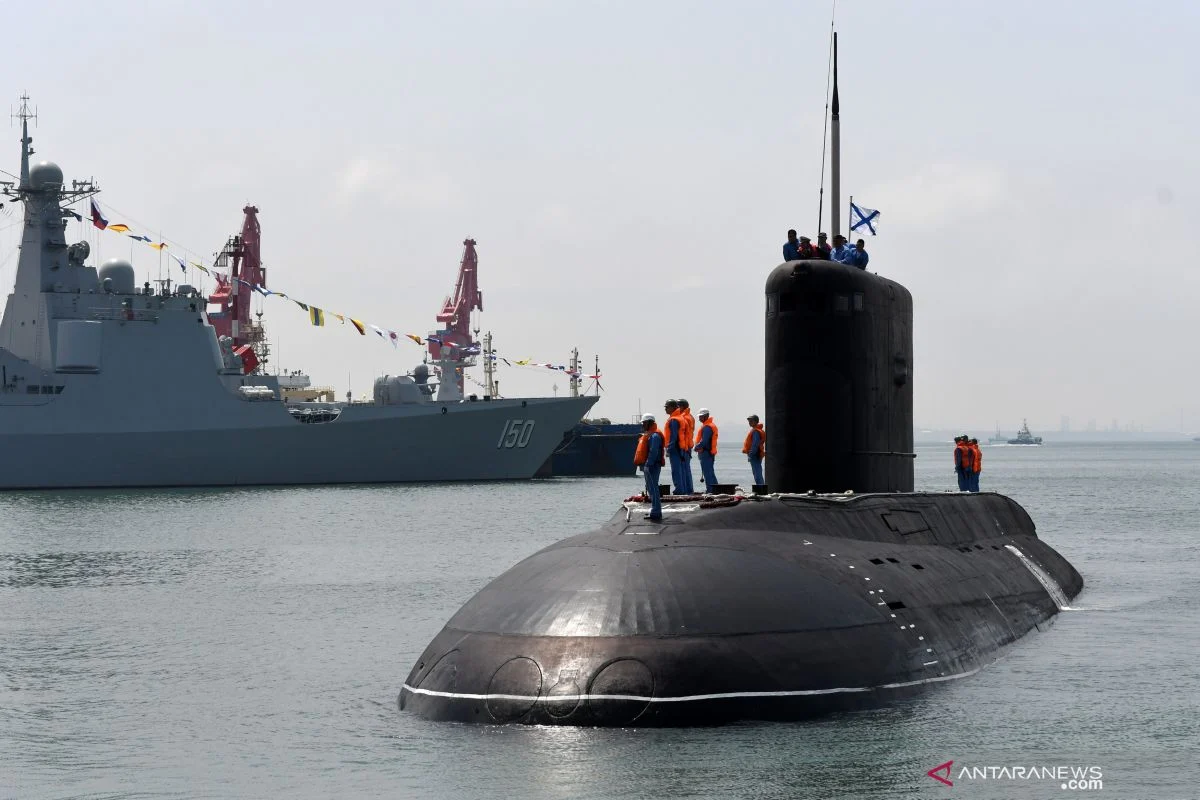
Media Kampung – 10 April 2026 | British Navy announced it intercepted a Russian submarine attempting to map undersea cables in the North Atlantic. The operation was carried out jointly with allied forces and air assets.
According to Defence Minister John Healey, a Royal Navy frigate and support vessel monitored the submarine continuously for more than a month. Sonobuoys and maritime patrol aircraft provided 24‑hour surveillance.
The submarine identified as an Akula‑class attack vessel was believed to act as a decoy for a second, smaller platform known as “Gugi”. The Gugi unit reportedly lingered near critical fiber‑optic routes and gas pipelines.
British forces deployed the Type‑23 frigate HMS St Albans, the replenishment ship RFA Tidespring and a Merlin helicopter to keep the Russian vessels in sight. RAF P‑8 Poseidon aircraft also contributed to the detection effort.
No damage to the undersea infrastructure has been confirmed, but officials warned that any sabotage could disrupt more than 99 % of global data traffic. The cables carry financial, commercial and governmental communications worldwide.

The Ministry of Defence described the Russian activity as “hostile conduct near vital undersea assets”. It added that the operation was concealed behind a pretext of Middle‑East events.
Russian military programs such as Gugi have long aimed to develop capabilities for both surveying and potentially destroying seabed installations. Experts say the programme could be activated in a conflict scenario.
The UK’s successful interception demonstrates the growing importance of anti‑submarine warfare in protecting digital and energy corridors. Allies have increased sonar deployments and shared intelligence to counter similar threats.
While the Atlantic incident unfolded, tensions rose again in the Persian Gulf where Iran’s mini‑submarine fleet operates. The Ghadir class, measuring 29 metre and displacing about 120 tonnes, is designed for shallow‑water missions.
Iranian media reported that the Ghadir vessels have been used to intimidate commercial traffic in the Strait of Hormuz after recent Israeli strikes in Lebanon. The narrow waterway remains a strategic chokepoint for oil shipments.
The Ghadir’s ability to dive to 30 metre allows it to evade surface radar and exploit the noisy environment of the strait. Its armament includes 533 mm torpedo tubes capable of launching heavyweight torpedoes.

Analysts compare the Ghadir’s size to that of a US Ohio‑class nuclear submarine, highlighting the stark difference in displacement and operational depth. Nevertheless, its small profile makes detection challenging.
Both the Atlantic and Gulf scenarios illustrate how modern navies must monitor a spectrum of undersea platforms, from large attack submarines to compact littoral vessels. Integrated sensor networks are now essential.
The UK’s operation relied on a combination of ship‑borne sonar, airborne sonobuoys and persistent aerial patrols. Such layered approaches reduce the window of opportunity for covert surveys.
In the Gulf, regional partners have called for de‑escalation and the reopening of safe navigation lanes. Pakistan, acting as a mediator, urged restraint from Iran, Israel and the United States.
Any disruption of undersea cables or pipelines could have cascading effects on global finance, internet services and energy markets. Governments are therefore tightening maritime security protocols.
The incidents also raise questions about international law regarding the use of international waters for intelligence‑gathering. While surveillance is not prohibited, interference with civilian infrastructure is considered hostile.

As both NATO and Gulf states reinforce their anti‑submarine capabilities, the balance between strategic deterrence and freedom of navigation will remain under close scrutiny. The situation underscores the strategic value of the oceans beneath the surface.
Artikel ini dipublikasikan oleh Media Kampung.







Tinggalkan Balasan