

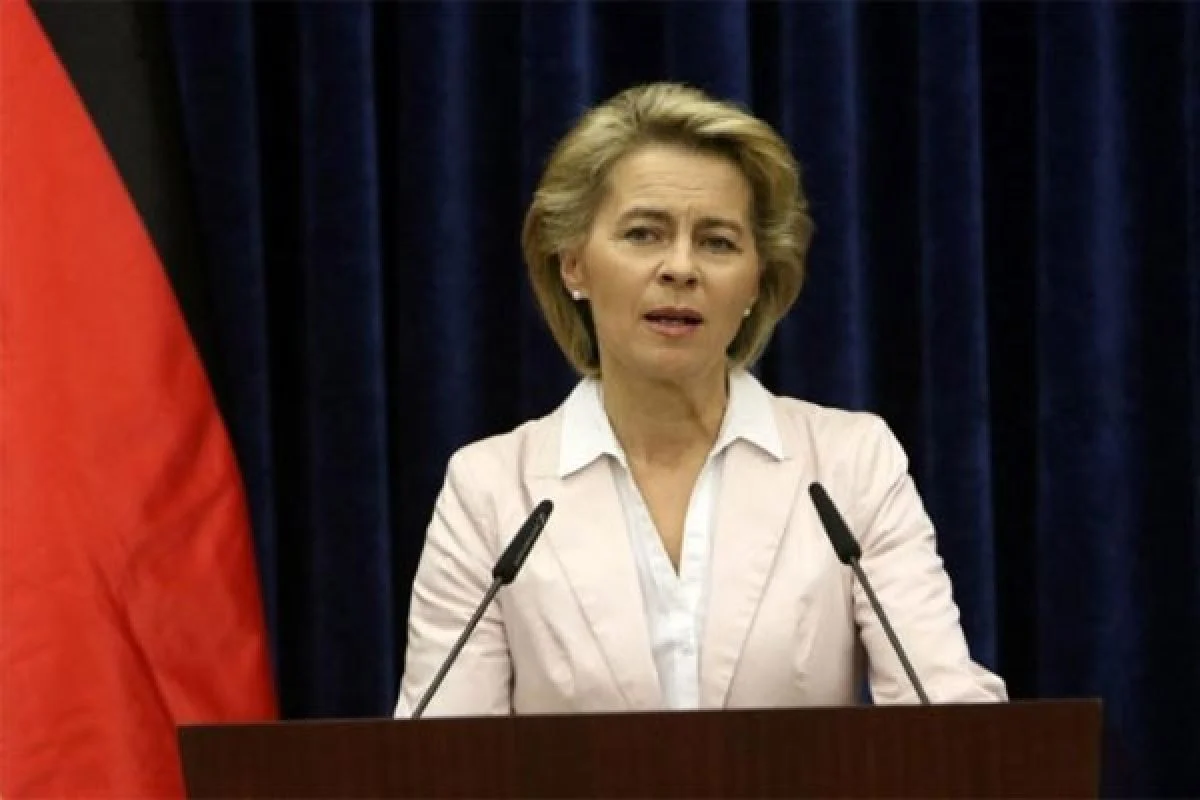
Media Kampung – 03 April 2026 | German government responded to US President Donald Trump‘s statement about withdrawing the United States from NATO, reiterating that Germany remains fully committed to the alliance.
The German spokesperson said the remarks are not the first from Trump and warned of possible consequences, but emphasized that the German government will continue to fulfill its NATO obligations.
Germany, as the largest NATO member in central Europe, hosts the biggest concentration of US forces, with about 35,000 American troops stationed on its territory.
According to Congressional Research Service data, the total US military presence in Europe reached roughly 80,000 personnel in 2024, spread across 43 bases, many of which are integrated with NATO command structures.
US contributions account for about 38 percent of NATO’s total active personnel, making Washington the alliance’s backbone in terms of manpower and budget.
In 2023, NATO’s collective defense spending amounted to 1.18 trillion dollars, of which the United States alone provided 823 billion dollars.
German officials argue that a sudden US exit would create a financing gap that could force European members to increase defense spending by up to 3 percent of GDP.
The International Institute for Strategic Studies warns that without American troops, Russia could exploit the vacuum in the Baltics as early as 2027.
German leaders also pointed to the legal framework of NATO, noting that any member wishing to leave must give one‑year notice under Article 13, a process that cannot be unilaterally overridden by a single president.
Nevertheless, US constitutional scholars argue that the president holds broad authority over international treaties, creating a potential legal clash if Trump attempts an abrupt withdrawal.
In response, Japan’s defence minister Minoru Kihara stressed the need for stable US‑Europe relations, stating that any disruption would threaten global security.
Britain’s prime minister Keir Starmer said the United Kingdom would act in its national interest but reiterated support for NATO’s collective defence.
French President Emmanuel Macron warned that repeated doubts about US commitment undermine the alliance’s credibility and could embolden adversaries.
The German spokesperson declined to comment on Trump personally, focusing instead on the continuity of Germany’s strategic partnership with NATO.
Germany’s central location makes it a critical hub for NATO’s rapid deployment forces and for the integration of air, land and cyber capabilities.
The presence of US bases such as Ramstein Air Base and the US Army’s European command in Stuttgart underscores the operational interdependence between Berlin and Washington.
Analysts note that the US contributes not only troops but also advanced intelligence, surveillance and reconnaissance assets that are shared with European allies.
If Washington were to withdraw, NATO would need to replace roughly 128,000 US personnel and fill gaps in ISR, a task estimated to cost about one trillion dollars.
German defence policy documents emphasize burden‑sharing, urging European members to raise defence spending to meet the 2‑percent of GDP target.
The German government has already increased its own defence budget to 185,600 personnel and 1.5 percent of GDP in 2024, signaling readiness to shoulder a larger share.
NATO’s Secretary‑General has called for unity, reminding members that collective security deters aggression from Russia and other potential threats.
Trump’s comments, made during a televised interview with the Daily Telegraph, framed NATO as a “paper tiger” and claimed that even Russian President Vladimir Putin recognizes its weakness.
German officials dismissed the characterization, stating that NATO’s operational record in Afghanistan, the Balkans and Eastern Europe disproves the “paper tiger” label.
The German foreign ministry also highlighted recent NATO exercises in the Baltic Sea, which demonstrated rapid reaction capabilities involving German, US and other allied forces.
While the US presidency can influence alliance politics, the German position remains that NATO’s strategic relevance transcends any single national leader’s rhetoric.
The German parliament is scheduled to debate the alliance’s future next month, but leaders expect the outcome to reaffirm Germany’s long‑term commitment.
In sum, Berlin’s message to Washington is clear: Germany will stay in NATO, maintain its force contributions, and work with allies to preserve European security.
Artikel ini dipublikasikan oleh Media Kampung.




Tinggalkan Balasan