

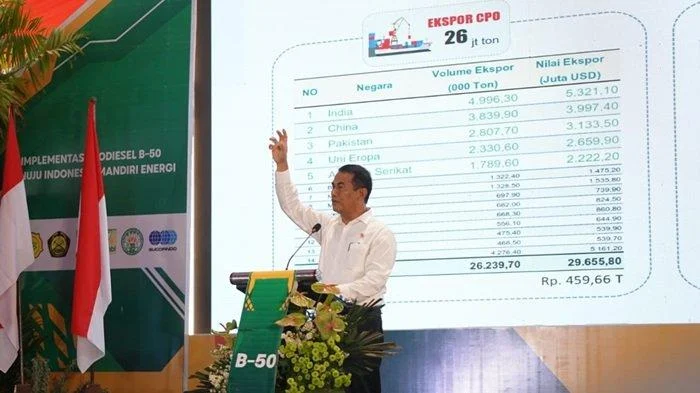
Media Kampung – 06 April 2026 | Minister of Agriculture Andi Amran Sulaiman confirmed on Tuesday that the mandatory 50 percent biodiesel blend (B50) will be operational by the end of 2026, rejecting recent industry pleas for a delay.
The appeal, lodged by a coalition of transport companies and fuel distributors, claimed that an abrupt shift to B50 would inflate fuel costs and disrupt logistics across the archipelago.
Amran countered that the government has already mobilized financial incentives, technical assistance, and infrastructure upgrades to ensure a smooth transition for all market participants.
He stressed that the B50 policy is integral to Indonesia’s broader energy security agenda, which seeks to lower reliance on imported petroleum while stimulating domestic agriculture.
The biodiesel mandate, first announced in 2020, obliges every liter of diesel sold for road use to contain at least half biodiesel produced from local feedstocks such as palm oil, Jatropha, and waste cooking oil.
Under the current schedule, refineries are required to adjust their processing units to accommodate the higher blend ratio, a move that the Ministry says will be completed by mid‑2026.
To support this shift, the government has allocated Rp 2 trillion in subsidies for biodiesel producers and granted tax incentives to fuel stations that meet the blend requirement.
Industry leaders warned that insufficient certified biodiesel inventory could force fuel retailers to revert to lower blends, risking non‑compliance penalties and consumer dissatisfaction.
In response, Amran assured that the Ministry’s monitoring system will track production volumes in real time and that any shortfall will be covered by strategic reserves.
He also announced that non‑compliant operators will face fines up to 5 percent of their annual fuel sales, a measure intended to reinforce accountability.
The B50 initiative aligns with Indonesia’s commitment under the Paris Agreement to cut greenhouse‑gas emissions by 29 percent by 2030, relative to business‑as‑usual forecasts.
By substituting half of the diesel with renewable feedstock, the policy is projected to reduce carbon emissions by roughly 30 million tonnes per year, according to a study by the Ministry of Environment.
Economists estimate that full implementation could generate an additional US$2.5 billion in biodiesel sector revenue, while creating up to 150 000 new jobs in rural processing centers.
Smallholder farmers stand to benefit as demand for palm oil and other oilseed crops rises, potentially increasing farm incomes and encouraging sustainable cultivation practices.
Nevertheless, critics argue that accelerated biodiesel production may exacerbate land‑use change and threaten biodiversity if not managed with stringent sustainability criteria.
The Ministry has responded by mandating certification under the Indonesian Sustainable Palm Oil (ISPO) scheme for all biodiesel feedstock suppliers participating in the B50 program.
International observers have noted that Indonesia’s aggressive biodiesel target positions the country as a regional leader in renewable fuel adoption, surpassing neighboring Malaysia and Thailand.
Trade analysts caution, however, that global palm oil price volatility could affect the cost‑effectiveness of B50, underscoring the need for diversified feedstock sources.
The government plans to expand research into second‑generation biodiesel, such as algae‑based oils, to reduce dependence on food‑crop feedstocks in the long term.
With the policy now reaffirmed, Amran urged all stakeholders to cooperate, stating that “the success of B50 rests on collective commitment and timely execution by industry, academia, and regulators alike.”
The firm stance signals that the mandatory blend will not be postponed, and that the upcoming months will focus on compliance checks, capacity building, and public awareness campaigns.
Observers conclude that the B50 rollout, if executed as pledged, will mark a significant step toward Indonesia’s renewable energy goals while reshaping the national fuel market.
Artikel ini dipublikasikan oleh Media Kampung.





Tinggalkan Balasan