

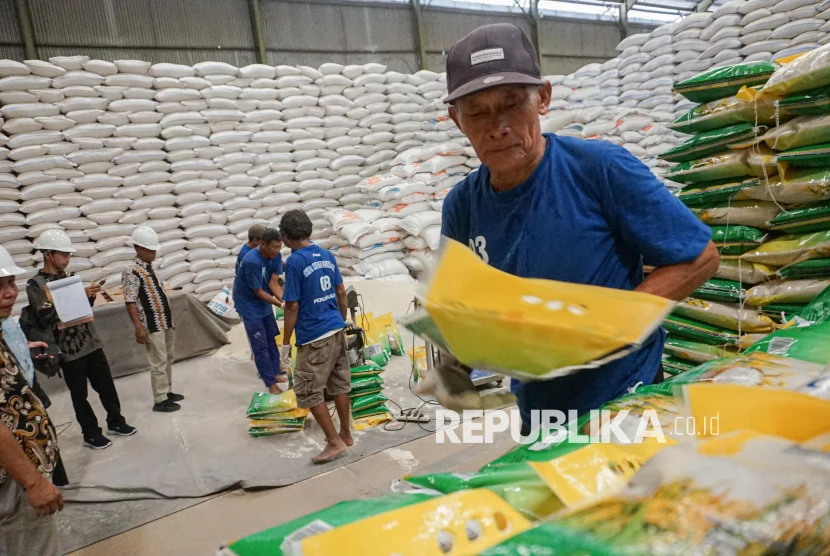
Media Kampung – 02 April 2026 | The Ministry of Agriculture announced that national rice reserves have risen to 4.3 million tonnes, positioning the country to confront the anticipated drought season beginning April 2026.
The figure surpasses previous levels and is expected to exceed five million tonnes by the end of the following month, according to Minister of Agriculture Andi Amran Sulaiman.
The surge results from an accelerated absorption program coordinated by the National Food Agency (Kabapanas) and the state-owned food corporation Bulog.
Between January and March 2026, the government successfully absorbed 1.3 million tonnes of domestically produced rice, a notable increase over the same period in earlier years.
If the projected additional one million tonnes for April materialises, total absorption for the first quarter plus April could reach 2.3 million tonnes.
Kabapanas reported that cumulative absorption for the first quarter of 2026 reached 1.39 million tonnes, outpacing historical benchmarks such as 90,000 tonnes in 2020 and 235,000 tonnes in 2021.
The upward trend continued after a dip in 2022‑2023, with a sharp rise to 719,300 tonnes in the first quarter of 2025, demonstrating the effectiveness of recent policy measures.
Minister Amran emphasized that the strengthened reserves provide a safety net for the population and guarantee food security throughout the dry season.
‘Our rice stocks are now at the highest level in recent history, and we expect to surpass five million tonnes soon,’ he said during a press briefing in Jakarta.
The government has set an ambitious target for Bulog to absorb four million tonnes of rice equivalents by the end of 2026, up from the three‑million‑tonne goal for 2025.
Meeting this target will reinforce the national strategic rice reserve (CBP) and sustain the self‑sufficiency status achieved at the close of 2025.
Analysts note that the increased absorption aligns with the need to buffer against the projected 0.38 million‑tonne decline in rice production expected by May 2026.
The anticipated shortfall stems from weather anomalies and lower yields in key producing regions, heightening the importance of robust stock levels.
By securing a larger buffer, the government aims to keep domestic rice prices stable and reduce the risk of import dependency during the drought.
The Ministry also plans to enhance distribution channels, ensuring that rice reaches vulnerable areas promptly as the dry season progresses.
Bulog will continue its procurement and storage operations, employing modern facilities to maintain grain quality throughout the extended storage period.
Stakeholders, including farmer groups and regional authorities, have expressed support for the intensified absorption scheme, citing its role in stabilizing farm incomes.
With the rice reserve now at 4.3 million tonnes and projected growth, officials are confident that Indonesia can safeguard food security against the upcoming 2026 drought.
Artikel ini dipublikasikan oleh Media Kampung.






Tinggalkan Balasan