

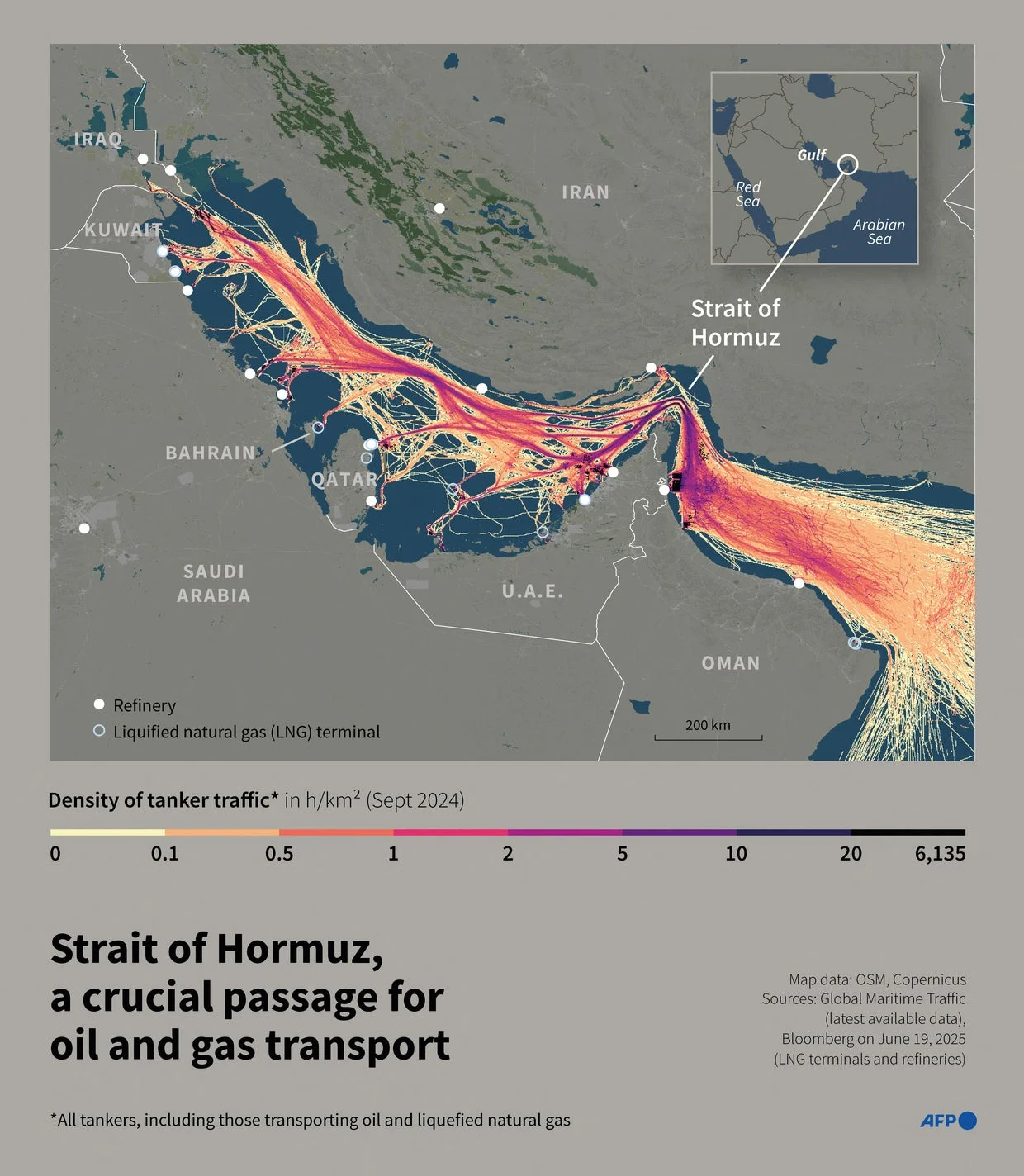
Media Kampung – 02 April 2026 | Iran’s recent closure of the Strait of Hormuz has reignited global concerns over energy security and maritime stability. The narrow waterway, through which roughly a fifth of the world’s oil passes, now faces renewed diplomatic and military calculations.
Washington responded by signalling a possible naval escort for tankers and by mobilising additional troops to the Middle East. President Trump emphasized diplomatic pressure but also hinted at a show of force to reopen the passage.
Despite the United States’ capabilities, analysts argue that the geography of the strait gives Tehran a decisive advantage. The channel narrows to about 38.6 kilometres at its tightest point, leaving only two main shipping lanes.
Senior researcher Nick Childs of the International Institute for Strategic Studies describes the chokepoint as a “high‑risk, low‑alternatives” zone. Any attempt to reroute vessels would be impractical, forcing ships to confront the Iranian coast directly.
Royal United Services Institute commentator Kevin Rowlands notes that the confined sea space limits maneuverability for escort vessels. Iran can therefore adopt a “wait‑and‑watch” posture, targeting ships that enter its radar range.
Iran’s coastline stretches nearly 1,600 kilometres along the Persian Gulf, providing ample launch sites for anti‑ship missiles. Mobile missile batteries can be concealed among rugged terrain, making pre‑emptive strikes difficult.
The northern Iranian terrain features hills, valleys, urban clusters and offshore islands, which further complicates threat detection. Such features enable rapid relocation of weapon systems, reducing the effectiveness of surveillance assets.
U.S. naval planners must also consider the risk of mines and asymmetric tactics that could disrupt a large‑scale escort operation. Deploying a permanent naval presence would stretch resources already committed to other regional hotspots.
Energy markets reacted sharply to the blockade, with crude prices spiking and futures reflecting heightened uncertainty. The disruption underscored the strait’s role as a linchpin of the global oil supply chain.
China, a major oil importer, has publicly urged calm and reiterated its commitment to energy resilience. Jakarta’s recent decision to allow Malaysian vessels free passage without fees illustrates regional attempts to mitigate the fallout.
The United Nations has called for an immediate reopening of the waterway, but enforcement mechanisms remain limited. Any multilateral naval intervention would require consensus among permanent Security Council members, a diplomatic hurdle.
Historically, Iran has leveraged the strait as a bargaining chip, using closures to extract concessions from adversaries. The current episode mirrors past incidents, where Tehran balanced domestic politics with strategic signaling.
Critics argue that a purely military solution could exacerbate civilian shipping losses and inflame regional tensions. A diplomatic pathway, involving indirect negotiations and confidence‑building measures, appears more sustainable.
Nevertheless, the United States maintains that freedom of navigation is non‑negotiable and that it will protect commercial traffic if necessary. Naval exercises in adjacent waters continue, serving both as deterrence and as a test of operational readiness.
Regional actors such as Saudi Arabia and the United Arab Emirates have voiced support for a swift reopening, citing economic imperatives. Their oil export capacities depend heavily on uninterrupted flow through the strait.
Experts warn that prolonged blockage could push oil‑dependent economies toward alternative routes, reshaping global trade patterns. Such a shift would diminish the strategic leverage Iran currently enjoys.
In the meantime, Iranian authorities have not indicated an imminent reversal, citing sovereign rights and security concerns. The stalemate persists, leaving shipping companies to navigate heightened insurance premiums and routing risks.
The situation highlights how geography, military assets, and international politics intertwine to keep the Strait of Hormuz a volatile flashpoint. Until a diplomatic breakthrough emerges, the waterway will likely remain a focal point of global attention.
Artikel ini dipublikasikan oleh Media Kampung.






Tinggalkan Balasan