

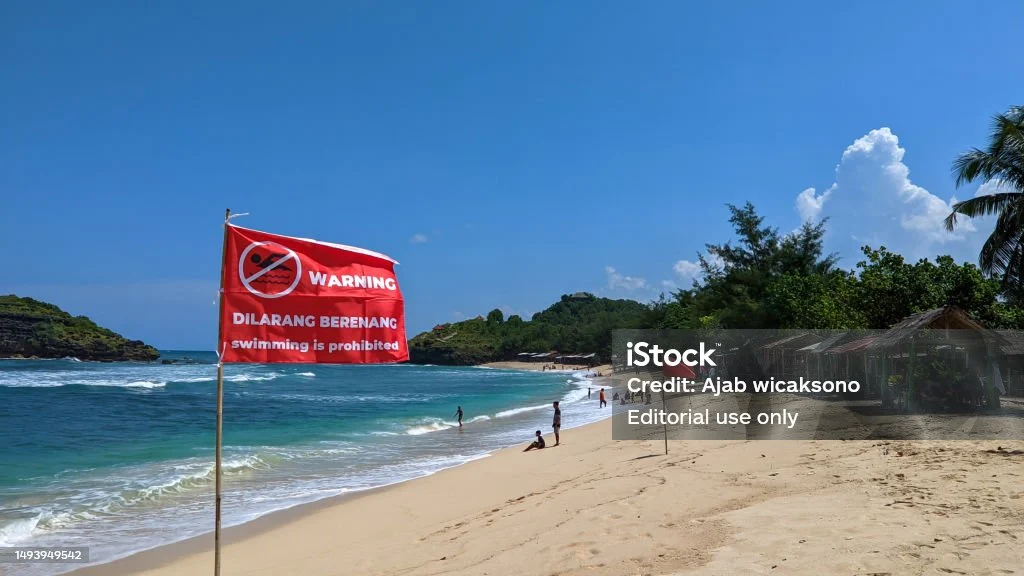
Media Kampung – 26 Maret 2026 | Authorities have issued an urgent advisory prohibiting swimming at Pantai Holtekamp after multiple drowning incidents in Lampung Selatan this week, citing the recent loss of lives and the heightened danger of rip currents.
The warning follows the disappearance of a 16‑year‑old teenager at Pantai Batu Rame on 24 March, when the victim was pulled away by a strong offshore current while swimming with friends.
Rescue teams from Damkar Lampung Selatan and Polsek Kalianda arrived promptly, conducted a night‑time sweep along the shoreline, and continued patrols the next day, yet they could not locate the missing teen before darkness fell.
Investigations identified hazardous rip currents and submerged rock formations near the coastal stretch, conditions that amplify the risk for swimmers and often go unnoticed from the beach surface.
On the same day, two young men, Fuad Abdillah (20) and Fikran Aulia Ulwan (19), lost their lives after attempting to rescue a peer at Pantai Mandiri Sejati, Krui, where powerful waves dragged them offshore despite their brief exposure to the water.
The pair were later found floating at distances of about 100 meters and 300 meters from the rescue site, illustrating the lethal reach of unexpected currents even for strong swimmers.
Local SAR units, including Dantim Rescue, Dharma Saputra’s team, and BPBD Pesisir Barat, coordinated an intensive search that involved multiple agencies and dozens of community volunteers working around the clock.
Despite the swift response, the incidents highlight a pattern of inadequate safety measures and limited public awareness about coastal hazards in the region, especially during holiday peaks.
Officials from the Lampung Disaster Management Agency emphasized that rip currents can form without warning and are not visible from the surface, making them especially dangerous for untrained bathers.
“Swimmers often underestimate the strength of these currents, assuming that shallow water is safe,” said Rully Fikriansyah, head of the local fire department, adding that the current can pull victims several meters per second, far faster than a casual swimmer can resist.
The disaster management office has placed multilingual warning signs at several popular beaches, including Pantai Holtekamp, Pantai Batu Rame, and Pantai Mandiri Sejati, urging visitors to stay on designated areas and avoid swimming altogether.
Police and tourism authorities have also increased patrols during peak holiday periods to enforce the swimming ban and to educate tourists on safe beach behavior through on‑site briefings.
Community leaders in Way Urang and Krui have organized local meetings, stressing the importance of immediate reporting of any drowning signs to emergency services and promoting the use of personal flotation devices.
Data from the regional SAR database shows a rise in water‑related accidents during the Lebaran vacation, with three fatalities recorded within 48 hours in Lampung Selatan alone, a sharp increase compared with the same period last year.
Experts attribute this surge to a combination of strong tidal flows, uneven seabed topography, and the influx of holiday crowds unfamiliar with the local marine environment.
In response, the provincial government plans to install additional lifeguard stations, equip them with rescue boats, and conduct regular drills that simulate rip current rescues to improve response times.
Tour operators are advised to revise itineraries, avoiding swimming activities at high‑risk beaches and offering alternative inland attractions such as cultural sites and nature parks.
The advisory remains in effect until thorough assessments confirm the safety of Pantai Holtekamp, and authorities urge the public to prioritize caution over recreation while the investigations continue.
As the search for the missing teenager continues, families and the broader community hope that the heightened safety measures will prevent further loss of life and restore confidence in coastal tourism.
Artikel ini dipublikasikan oleh Media Kampung.






Tinggalkan Balasan