

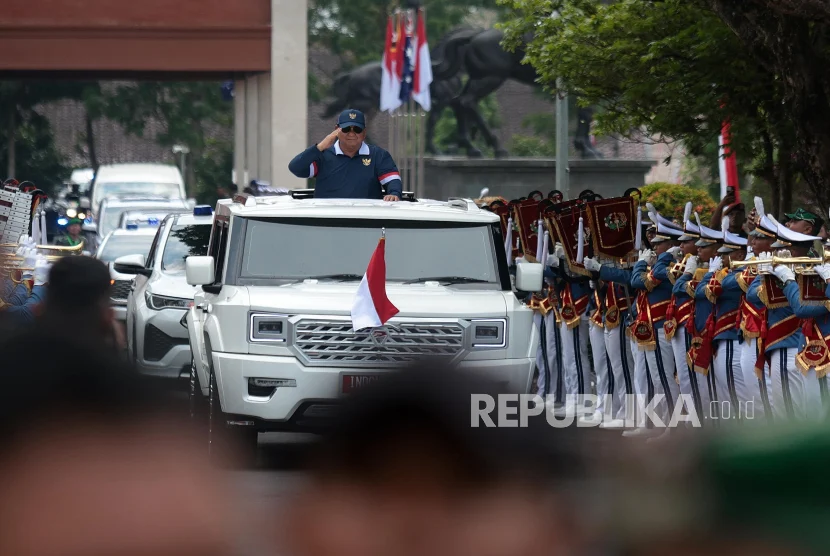
Media Kampung – 20 Maret 2026 | President Prabowo Subianto criticized the purchase of a governor’s official vehicle costing around eight billion rupiah, calling it excessive amid unmet basic infrastructure needs. He highlighted the disparity between such spending and the modest price of the domestically produced Maung vehicle used by the president.
In a press briefing at his residence in Hambalang, Bogor, Prabowo compared the governor’s procurement with his own official car, stating that the Maung, equipped with bullet‑proof features, costs roughly seven hundred million rupiah, or about one billion if armored. He argued that the governor’s cost was unjustifiable.
The president urged regional administrations to prioritize essential projects such as village bridges, which many localities have left incomplete. He questioned the management of Village Fund allocations, asking where the money allocated to regents and governors actually goes, and warned that central authorities would intervene if needed.
Following the criticism, East Kalimantan Governor Rudy Mas’ud returned the newly purchased official vehicle, valued at 8.49 billion rupiah, to the regional treasury. The decision was presented as a response to public outcry and the president’s call for greater fiscal responsibility.
Prabowo emphasized that the central government stands ready to oversee and correct misuses of public funds, especially when they affect the welfare of ordinary citizens. He called on local leaders to demonstrate accountability and to avoid expenditures that serve personal prestige rather than public benefit.
The president also addressed the broader issue of frequent work‑visits that inflate travel expenses, urging officials to conduct such trips only when truly necessary. He suggested a systematic audit of travel costs and other discretionary spending to ensure transparency.
Critics of the governor’s purchase argue that the vehicle, imported or locally assembled, offers features far beyond the operational needs of provincial administration. They claim the high price reflects a culture of status‑seeking among some regional officials.
Supporters of the Maung argue that the domestically produced SUV meets security requirements for high‑ranking officials while supporting the national automotive industry. The vehicle’s price, they note, includes armor and communication systems, yet remains considerably lower than the eight‑billion‑rupiah model purchased by the governor.
Analysts note that the disparity highlights ongoing challenges in Indonesia’s fiscal decentralization, where regional budgets often lack stringent oversight. They recommend clearer guidelines on capital expenditures and stronger coordination between central and local finance offices.
The president’s remarks came during a ceremony marking the Indonesian Armed Forces’ anniversary, where he addressed a crowd of thousands from the back of his white Maung. He used the platform to stress that public resources must serve the people, not personal comfort.
While the governor’s decision to return the car may mitigate immediate criticism, observers say it does not resolve the underlying issue of unchecked spending at the regional level. They call for institutional reforms that embed performance‑based budgeting into local governance.
The episode underscores President Prabowo’s focus on fiscal discipline as a cornerstone of his administration’s agenda. It remains to be seen how regional authorities will align their spending priorities with the central government’s call for efficiency and transparency.
Artikel ini dipublikasikan oleh Media Kampung.

Tinggalkan Balasan