

Media Kampung – 29 Maret 2026 | Vienna announced a legislative package that will prohibit users younger than 14 from accessing major social platforms such as TikTok, Instagram, X and Snapchat.
The measure is presented as a response to growing evidence that digital services foster addictive behaviour among minors.
Vice‑Chancellor Andreas Babler, also serving as Media Minister, said the state cannot remain passive while profit‑driven algorithms jeopardise children’s health.
“We must treat digital addiction with the same seriousness as alcohol or tobacco,” Babler asserted during a press conference.
Education Minister Christoph Wiederkehr added that responsible use of technology requires clear legal boundaries to protect young users.
The draft law targets platform characteristics rather than individual apps, focusing on features that maximise dwell time and user engagement.
According to the government, these algorithmic designs deliberately encourage continuous scrolling, which research links to anxiety and sleep disorders in adolescents.
Austrian officials cite data from the state protection agency indicating a sharp rise in extremist recruitment online, with suspects under 18 accounting for nearly half of cases last year.
The age threshold of 14 aligns with the legal age of majority in the European Union and with General Data Protection Regulation provisions.
To enforce the ban, the government proposes a two‑stage online age verification that relies on zero‑knowledge proof technology.
This cryptographic method would confirm a user’s age without revealing personal identifiers to the platform.
Officials claim the approach safeguards privacy while ensuring that under‑age accounts cannot be created.
Critics warn that such verification may be technically challenging and could infringe on fundamental rights.
Michael O’Flaherty, Human Rights Commissioner of the Council of Europe, described blanket bans as neither proportionate nor necessary.
He emphasized that digital participation and access to information are essential for modern education and civic engagement.
A study for the European Parliament highlighted that comprehensive age checks risk creating new data‑collection loopholes.
The report concluded that democratic societies must balance youth protection with respect for privacy and freedom of expression.
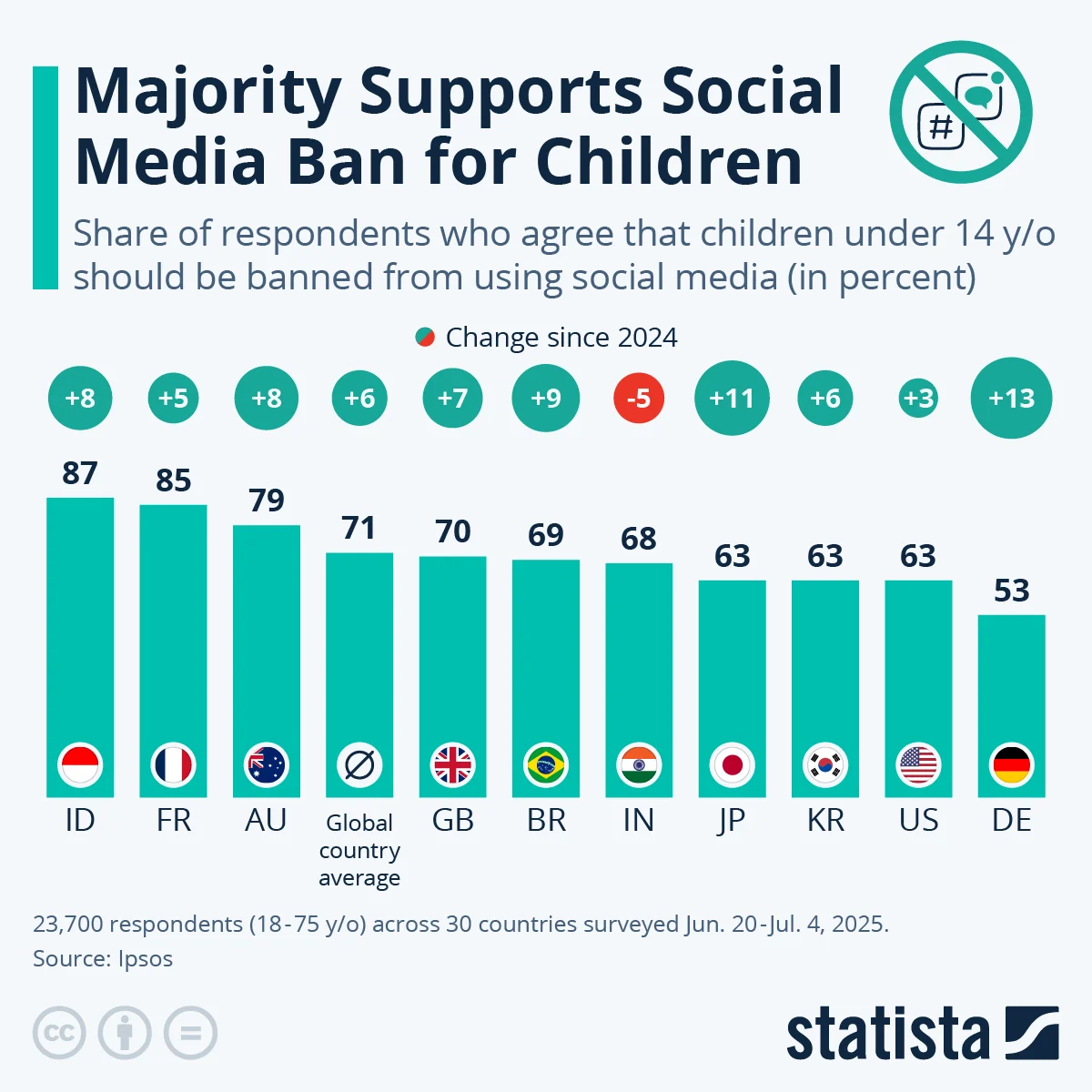
Austria joins a growing list of nations that are tightening rules for minors on social media.
Australia introduced a ban for under‑16s in December 2025, becoming the first country to enact such a measure.
France’s lower house approved a prohibition for under‑15s earlier this year, and the French president publicly welcomed Austria’s initiative.
The United Kingdom has launched a public consultation on extending bans to under‑16s, while Denmark, Greece, Spain and Ireland are debating similar limits.
In the United States, a recent jury verdict found two major platforms liable for designing addictive algorithms that harmed young users.
Social media companies argue that their terms already prohibit accounts for children under 13, though enforcement varies.
They also point to parental‑control features that can be activated upon request.
Nevertheless, Austrian policymakers argue that existing safeguards are insufficient and that legal mandates are required.
The proposed law is expected to be formalised into a draft by the end of June and will undergo parliamentary debate.
If passed, Austria would become the first European nation to enforce a blanket ban for children under 14 across all major platforms.
Industry observers note that the measure could set a precedent for broader EU regulations on digital addiction.
Technology experts caution that the effectiveness of age verification depends on cooperation from platform providers and robust cybersecurity standards.
Meanwhile, parent groups have expressed mixed reactions, with some welcoming stronger protection and others fearing loss of educational opportunities.
Overall, the Austrian initiative reflects heightened political pressure to address the mental‑health impact of pervasive social media use among youth.
Authorities plan to monitor the policy’s outcomes closely and adjust the framework based on empirical evidence.
As the debate continues, Austria’s move signals a decisive shift toward stricter digital governance for the next generation.
Artikel ini dipublikasikan oleh Media Kampung.







Tinggalkan Balasan