

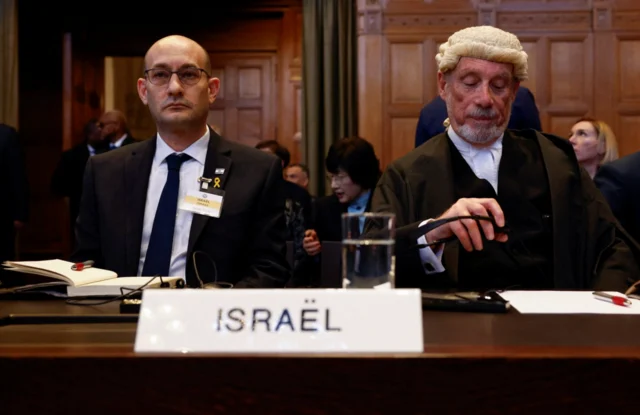
Media Kampung – 20 Maret 2026 | Germany announced today that it will withdraw its backing for Israel in the ongoing case at the International Court of Justice (ICJ). The decision marks a sharp shift after years of diplomatic support.
The ICJ case concerns accusations that Israel has violated international law through its settlement activities in the occupied West Bank. Germany’s reversal comes as other European nations reassess their positions.
German Foreign Minister Annalena Baerbock said the move reflects “a growing concern over the legal implications of settlement expansion.” She added that Germany must align its foreign policy with the principles of international law.
Berlin’s statement cited recent United Nations reports indicating increased settlement construction and related human‑rights abuses. The government indicated it would no longer vote in favor of Israel’s legal arguments at the court.
The decision surprised Israel’s diplomatic corps, which had expected continued German backing. Israeli ambassador to Germany, Ron Prosor, described the move as “unfortunate and detrimental to the bilateral relationship.”
Analysts view Germany’s step as part of a broader European trend toward stricter scrutiny of Israeli policies. A senior fellow at the German Institute for International and Security Affairs noted that “political pressure from civil society is reshaping government stances.”
The ICJ hearing, scheduled for later this year, will now proceed without German support for Israel’s position. Other permanent UN Security Council members, including the United States, remain steadfast in their backing.
In a parallel development, FIFA concluded its disciplinary proceedings against the Israel Football Association (IFA). The governing body imposed a fine of 150,000 Swiss francs for breaches of anti‑discrimination rules.
FIFA’s disciplinary committee found that the IFA failed to address repeated racist incidents involving fans of Beitar Jerusalem. The sanction also requires the federation to display anti‑discrimination banners in three upcoming matches.
The Palestinian Football Association (PFA) had petitioned FIFA for stronger measures, arguing that Israeli clubs operating in West Bank settlements should be barred from competition. FIFA rejected that request, citing the unresolved legal status of the territories.
FIFA’s rationale emphasized that the status of the West Bank remains a complex issue under public international law. The organization argued that intervening in the matter could exceed its sporting mandate.
Human‑rights groups welcomed the financial penalty but criticized FIFA for not taking harsher action. Amnesty International called the decision “insufficient” and urged UEFA to suspend Israeli clubs in occupied territories.
The PFA’s appeal to the FIFA Council in Bangkok was discussed in the 74th Congress in May 2024. The council ultimately adopted the Governance, Audit and Compliance Committee’s recommendation to maintain the status quo.
German officials expressed that the country’s stance at the ICJ does not automatically translate into sporting sanctions. Baerbock clarified that “political decisions at the diplomatic level differ from the jurisdiction of sports bodies.”
Nonetheless, the coincidence of Germany’s diplomatic shift and FIFA’s modest sanction has intensified debate about consistency in international responses to Israel. Critics argue that selective pressure undermines the credibility of multilateral institutions.
The German foreign ministry indicated it will continue to support peace initiatives that adhere to UN resolutions. It also announced a review of bilateral aid programs linked to settlement activity.
Meanwhile, the IFA appealed the fine, stating that the punishment does not reflect the severity of the alleged violations. The association plans to submit a formal complaint to the Court of Arbitration for Sport.
The ICJ case will now proceed with fewer allies for Israel, potentially affecting the court’s deliberations on the legality of settlements. Legal scholars predict that the outcome could set a precedent for future territorial disputes.
Observers note that both diplomatic and sporting arenas are increasingly used as platforms for political expression. The convergence of these domains underscores the complexity of enforcing international norms.
As Germany recalibrates its foreign policy and FIFA maintains a limited punitive approach, the international community watches how these actions influence Israel’s standing. The developments highlight the growing demand for accountability across diplomatic and athletic fields.
Artikel ini dipublikasikan oleh Media Kampung.







Tinggalkan Balasan